Xscaping Limits Blog Series #6: A Figure of Merit for Xscaping Cu in Scale-Up

Introduction
In our last blog, Xscaping Limits #5, we introduced the three fabrics that stitch an AI datacenter together: scale-up, scale-out, and scale-across. Each fabric has its own bandwidth, reach, and latency requirements — and each is at a different point in its journey from electrons to photons.
Scale-out made its transition long ago; single-mode optics is the standard there today. Scale-up, however, remains firmly copper — and the roadmap for future scale-up needs is something of a wild west. Companies are experimenting with different approaches and lobbying hard for their own, but there is no real consensus about where optics belongs in the architecture, when it becomes necessary, or which architecture makes the most sense as bandwidth demands keep climbing.
When a market is this noisy, opinions are cheap. What we need is a quantitative yardstick — a figure of merit that lets us estimate, from first principles and from history, when the transition away from copper becomes economically and technically inevitable. Fortunately, the communications industry has been using exactly such a metric for half a century.
Bandwidth-Distance Product as a Figure of Merit
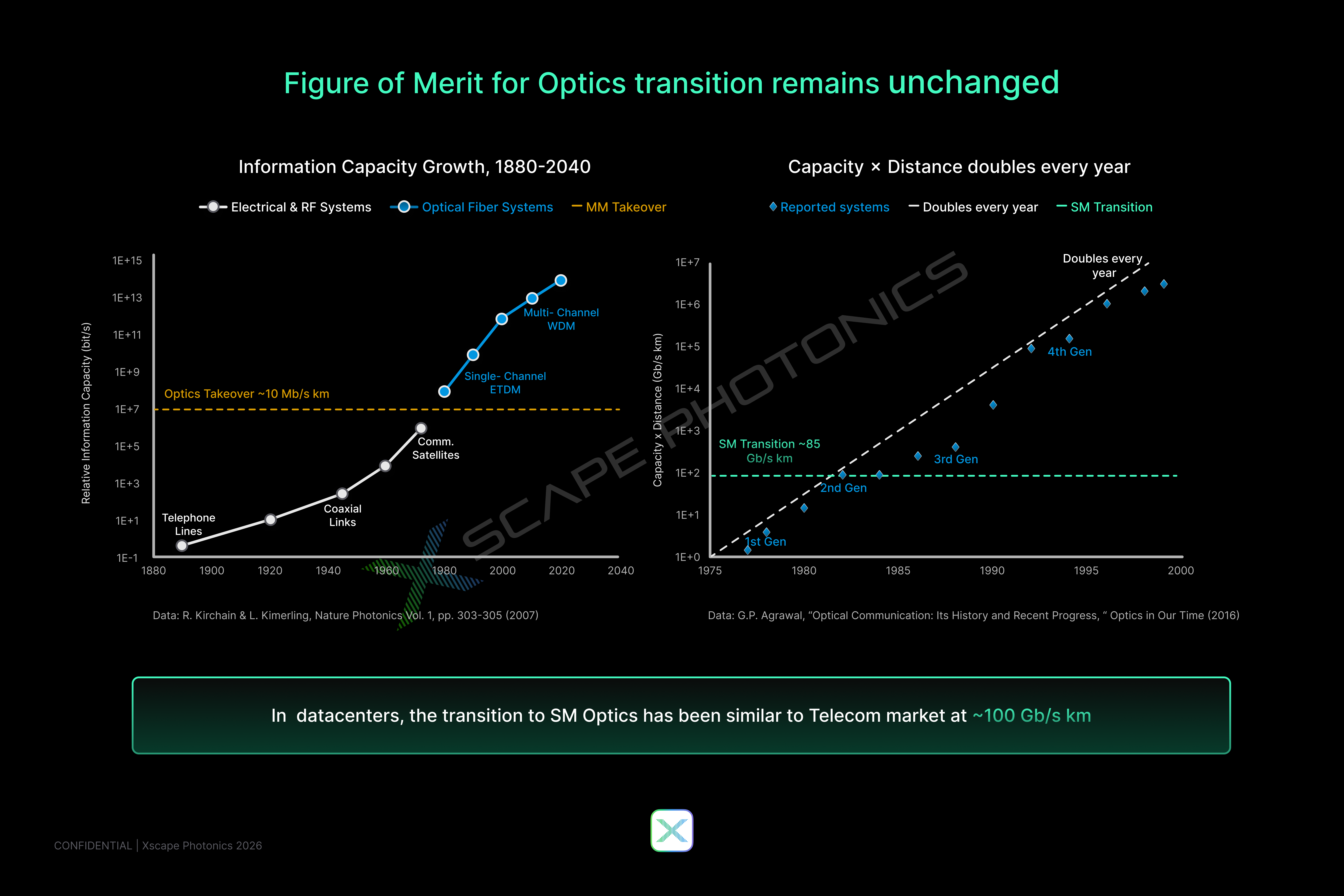
The product of bandwidth and distance — how much data you can move, multiplied by how far you can move it — has long served as the figure of merit for communication links. It's what first drew me into photonics fifteen years ago: my professor had published the bandwidth-distance product as the key metric for deciding when a link should change physical media, and the historical record backs it up remarkably well.
Look at the left panel of Figure 1, which traces information capacity from telephone lines through coaxial links and communication satellites to optical fiber. The transition from copper to optics in long-haul telecom became economically viable at roughly 10 Mb/s·km. Below that threshold, copper won on cost and simplicity. Above it, the physics of resistive metal — loss, dispersion, power — made optics the only sensible answer.
The right panel tells the second half of the story. The first optical deployments in the 1970s were multimode. As capacity demands grew, the industry crossed to single-mode fiber at around 85 Gb/s·km — and from there, the bandwidth-distance product of deployed systems has doubled roughly every year for decades. What powered that relentless doubling? First electronic time-division multiplexing on a single channel, and then, decisively, wavelength-division multiplexing (WDM) — putting many colors of light on a single fiber. WDM is the mechanism by which the figure of merit kept scaling long after a single channel ran out of headroom.
Here's what I find remarkable: these transition points have barely moved in fifty years, despite everything else in technology changing beyond recognition. That stability is precisely what makes bandwidth-distance product so useful as a predictive tool. If it governed telecom's transitions, it should govern the datacenter's too. So let's apply it.
BW-Distance FoM Inside the Datacenter
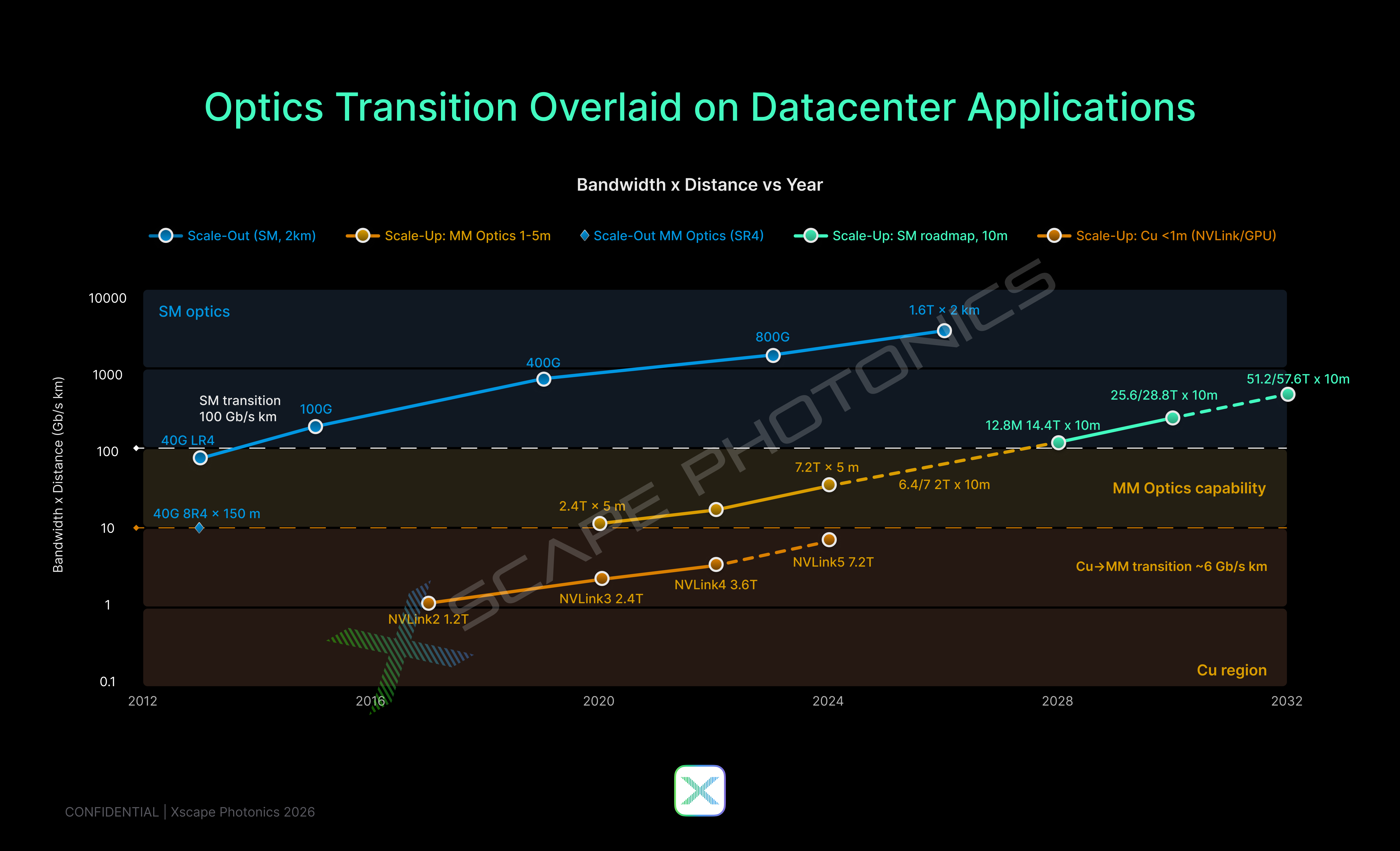
Figure 2 overlays the datacenter's actual link evolution — scale-out and scale-up — on the same bandwidth-distance axes, with the copper, multimode, and single-mode regions shaded.
Scale-out has already replayed telecom's history. Inside datacenters, short-reach multimode links (40G SR4 over 150 m) served the early years, but as switch-to-switch bandwidth climbed from 40G LR4 through 100G, 400G, and 800G to today's 1.6 Tbps over 2 km reach, scale-out crossed into single-mode at roughly 100 Gb/s·km — strikingly close to telecom's ~85 Gb/s·km crossover. Today's 1.6T × 2 km links sit at 3,200 Gb/s·km, deep in single-mode territory. Same figure of merit, same transition point, different market.
Scale-up is now approaching its own crossing. The GPU-to-GPU fabric has ridden copper from NVLink2 at 1.2T through NVLink3 (2.4T), NVLink4 (3.6T), and NVLink5 at 7.2T — all within a meter of reach. The copper-to-multimode transition sits at roughly 6 Gb/s·km, and NVLink5 is brushing against it. From here, the physics lays out three regimes by reach:
- Copper remains viable within ~1 m — essentially, inside a single rack.
- Multimode optics (LED- and VCSEL-based) covers roughly 1–5 m — a few adjacent racks.
- Single-mode optics takes over beyond ~10–20 m — row-scale and beyond.
And here is where system architecture becomes the deciding variable. Inference cluster sizes are scaling fast, and cluster size maps directly onto reach: one rack is ~1 m of reach, three racks is ~5 m, and four or more racks pushes past 10 m. The reach requirement isn't chosen by the interconnect designer — it's dictated by how many accelerators the model needs in one coherent domain. That makes the multimode-versus-single-mode choice genuinely difficult: a scale-up domain that fits in three racks today may need ten racks next generation.
The forward roadmap sharpens the question. At 12.8 Tbps per GPU over 10 m of reach — roughly a 2028 design point — the per-GPU figure of merit reaches 128 Gb/s·km, right at the historical single-mode transition threshold. Aggregate the fabric and the numbers are even more emphatic: 100 Tbps across 10 m is 1,000 Gb/s·km, an order of magnitude beyond where multimode has ever made sense.
So the open question for the industry is this: does scale-up pass through a multimode transition phase on its way to single-mode, as telecom did in the 1970s — or does the sheer pace of inference cluster growth and model size growth compress that phase to nothing, making a direct jump to single-mode the rational choice? Telecom had decades to traverse multimode. Scale-up may have a single product generation.
Either way, the deeper point stands: model size is a fundamental architectural input. The size of the models you intend to serve dictates the size of the inference cluster, the cluster size dictates the reach, and the reach — through the bandwidth-distance figure of merit — dictates the interconnect physics. These systems must be architected around that chain from the very beginning, not retrofitted after the fact.
Conclusion — Xscaping Limits
Across this series, we've traced a single arc: #1 framed the hard ceiling facing AI systems as they chase human-scale intelligence; #2 showed that scaling AI is no longer a compute problem but an infrastructure problem; #3 identified the copper wall — the escape-bandwidth bottleneck where data leaves the package; #4 made the case for why AI clusters need optics, with photons replacing electrons as the carrier of information; and #5 mapped the optical networks — scale-up, scale-out, and scale-across — that connect AI.
This installment adds the yardstick. The bandwidth-distance figure of merit that governed telecom's copper-to-optics transition, and scale-out's after it, now points squarely at scale-up: as per-GPU bandwidth and reach requirements climb toward 12.8 Tbps over 10 m, scale-up crosses the same single-mode threshold every fabric before it has crossed. And just as in telecom, the technology that scales the figure of merit from there is WDM — many wavelengths on a single strand of single-mode fiber, multiplying bandwidth without multiplying fibers, power, or cost.
Tomorrow's AI should be designed as a hardware-software co-design: model sizes dictate inference cluster size, cluster size dictates reach, and reach dictates the right optics. The figure of merit has been telling us the same story for fifty years. It's time scale-up listened.